Wednesday, October 25, 2017

Leaving

Hi friends,

I'm leaving Google at the end of next week.

There's too much I want to say.  :)

I spent the summer away from work, outdoors in Oregon, awash in beauty.  I learned a lot.  I wept at how we're treating the earth, as I rode past mile after mile of logged forests, polluted streams, and lifeless monocrop fields.

I got to be part of what I'll call "alternative culture", to explore ways of meeting all of our human needs through local community alternatives to basically everything we currently use money for.  I wrote some about this time here on this blog.  I barely scratched the surface though.  More and more people, perhaps millions now even in the West, are devoting their lives to new (and sometimes ancient) ways of living in healthy relationship with each other and with the earth.  While they are usually partly within the current system, when all of these new ways of living come together, the current system becomes obsolete.  I see joyous glimpses of this everywhere.

Meanwhile our dominant civilization is killing its own foundation: the healthy web of life on earth.  Through deforestation and pollution we are destroying the ability of the planet to support all forms of life.  We can see this in the oceans where the fish populations are collapsing, the silent fields that were once thriving forests, and the deserts where millions of people go hungry in drought.  This ecological crisis can't be solved simply by swapping oil for solar panels.  I'm no longer optimistic that we will soon fix these problems with some new technology.  It looks like climate change is exacerbating the storms and droughts and fires, and seems likely these will continue to become more and more severe in the next years.

The effects are not evenly distributed.  The unhoused breathe wildfire smoke while many of the housed have filtered air.  Some of us see our homes flooded or burnt while for others business continues as usual.  Most communities in the country and increasingly in the world have lost the ability to sustain themselves from their land, and now must import almost everything they need from elsewhere, which becomes precarious when those importing the goods see no profit in it (food deserts), or when disaster breaks down the supply line like in Puerto Rico.  Many communities no longer have access to clean water, or are losing it as I write.  On Monday I listened to a man from Guatemala talk about a new silver mine near his home that is polluting and drying up the water supply for many villages there.  Almost all silver is used to produce electronics, and demand is rising.  In Oregon this summer, ancient trees thousands of years old were cleared for fire breaks.  The entire planet is being saturated with chemicals that we ought never to have created.  These kinds of damage cannot be undone or fixed by technology.  The story for other species is even worse, as most wild animal populations have died off and we pack billions of animals in cages in horrific factory farms.  The coral reefs, the rhinos, the ancient forests, the whales, and even the insects... who speaks for them?  Some people do, and they end up in jail if their actions threaten profits.  Profits are made at the expense of Life.

And within our civilization, we have more prisoners and refugees, more drugs and anxiety and depression and stress and addiction than ever.  Even in wealthy regions, most people don't like the work they do all day.  It's also not physically healthy to be indoors or using a computer or riding in vehicles for as many hours as many of us who are "successful" do.  What is happening to us?

It seems the leaders of our world are apathetic or powerless, as they fight over the most gaudy deck chairs on this titanic.  While it pains me, I don't hate them for this; their actions are the product of a traumatic history that touches all of us.  They don't know what they're doing.

I envision a more beautiful world where humans have a healthy part to play, to love and respect the earth, not to dominate and exploit it.  I see many people living that vision already, and want to live my life in service to it.  I see the extremes of both ugliness and beauty grow more stark.  Ugliness as we close down and protect ourselves from the 'other', beauty as we come together in community, in love with mother earth.  Will "society" as a whole make some kind of transition, or continue the march into dystopia and eventual chaos?  I don't know.  It will be both at the same time.  Some people are already in an obvious dystopia, some are in a beautiful place yet in the shadow of a collapsing ecosystem.  To hope for a peaceful transition would be to ignore the incredible violence on which the current system lives.  It will be violent because it already is.  May we learn to be kind to each other as these changes unfold.

It's been said that we need the darkness to see the stars.  We can open ourselves to what is happening, feel and honor our pain, grieve what is lost, and revel in our deep gratitude for the beauty of life.  I don't mean to be a downer pointing at all this ugliness.  I feel that we have a deep need to see it and acknowledge it.  It makes the beauty that much more precious and worth living for.

“Tell me, what else should I have done?
Doesn't everything die at last, and too soon?
Tell me, what is it you plan to do
With your one wild and precious life?”
-Mary Oliver

What should we do then?

I don't know exactly what we should do.  I don't have a rational "here's what everyone needs to do" that will resolve all of these crises.  I want to let go of my need to control what happens, because I'm really not in control.  At the same time, even if I let go and accept whatever comes, I am a human being and it is natural for me to care and want to help, to serve what I love.  I will not deny that part of me either.  So I find myself thinking about how to help, even if it seems "hopeless" overall.  I need not stress about the outcomes, but I will still act.  What else would I do with my few short years here?

So what might I do to be practical?

I don't believe our technology is serving us well.  We, the wealthy humans near the top of the power hierarchy may see it as indispensable, but if we consider the animals or the fish or the trees or the laborers in the sweatshops and mines and plantations, it's not working out so well.  Yes, our technology relieves some suffering in some places, but at what cost?  We simply do not, and probably cannot, count the costs of development.  I am not enthusiastic that further technological progress will heal us.

I also don't believe that our problems are mostly due to money being in the wrong hands.  Measuring everything by monetary value seems to me one of the roots of the crises.  The mentality that values money over life drives much of the pollution and resource extraction and oppression around the world, since humans first accumulated "property" and enslaved each other.  I don't feel that getting as much money as I can and giving it to the non-profit side of the system is the best way for me to serve what I love.  I feel that the money abstraction and the distance it puts between us and the effects of our actions makes us feel disconnected and alone.

I also don't like our culture's valuing of measurable impact over everything else.  Much of what is precious to me cannot be measured.  What's the measurable value of a 5000 year old yew tree?  What's the measurable value of caring for a disabled child?

“May what I do flow from me like a river
no forcing
and no holding back
the way it is with children.”
-Rilke

So I don't know what we all should do exactly, and I don't know what I will do beyond the short term.  I'm skeptical of money and the dominant culture's value system.  I want to trust what makes me feel alive over our culture's normal stories that usually are rooted in fear.  I recognize that I'm one of the most privileged people in the world.  I know most people do not have the options that I have.  I don't mean to judge, only to encourage.

Right now what's happening is I've been living in a homeless protest encampment in Berkeley the last couple months, which has given me still another perspective on our society.  It got interesting this weekend and we're fighting eviction, hoping to benefit and inspire homeless communities around the country.  With all of the disaster and war refugees today, and housing crises in many places, there are more and more people who can't have regular housing, and we could learn to live together with more kindness and understanding.  I'm also involved with the community here in other ways like Food Not Bombs.  I expect soon I'll be moving on to other places, to learn and to live in service to what I love.  To restore soil and help plants grow and be community.

I've learned I don't need much money to live well myself, so I don't need to earn it for myself.  Perhaps my perspective on money and impact will change and I'll eventually decide that earning money and supporting my many friends who don't have much money in their various causes is the best way to contribute, and then I might return to a job, but we'll see.  "It is no measure of health to be well adjusted to a profoundly sick society."

Wherever I am, I'll be with some kind of community learning how to live in healthier relationship with each other and with the earth.  There'll be dark moments and joyous moments, and this is life.  Life is good.  Whatever comes, I will give attention to the beauty around me, the beauty of community and of nature and of every form.  Beauty everywhere begs our attention.

“An eye is meant to see things.
The soul is here for its own joy.

A head has one use: For loving a true love.
Feet: To chase after.

Love is for vanishing into the sky. The mind,
for learning what men have done and tried to do.

Mysteries are not to be solved: The eye goes blind
when it only wants to see why.”
-Rumi


Wednesday, August 30, 2017

On Simple Living

When I talk about simple living, I'm referring to living in ways that are less harmful -- that require less destruction and pollution and oppression.  People might also use "simple living" to mean having a less cluttered house, or a large house where their few possessions leave lots of empty space.  That's a different thing -- one could have that kind of simplicity and still spend a lot of money in support of harmful industries, and pay for a lot of violence and destruction.  We can even spend our weekends protesting against the government and corporations who are carrying out this violence and destruction, while the rest of the week we produce and consume in support of them.  One hand is holding a sign saying "Stop!" while the other hand is giving our money to the object of our protest, implicitly saying "keep it up!".

So simple living is a way to put our money where our mouth is -- in other words, take a holistic view, to integrate all parts of our life into a whole, we might say to live with "integrity".  The reason we practice this kind of simple living is that we desire to be kind to those we love, and recognize that we love all beings -- ourselves, other people, animals, and I say even the trees and mountains.  The same way we try to be kind to those closest to us, and we try to avoid harming them, we can practice being kind and avoiding harm to all.  When this happens, we are more able to appreciate and enjoy the beauty of all beings, similar to how we are able to appreciate and enjoy the beauty of those we love most.

So what could simple living look like in 2017 America?

I can't imagine there's a single general answer, but all of us have steps in this direction that we could take.  Everyone who wants to be kind and stop harming others will find some steps easier to take than others.  There are steps that will be easy for one person to take, while being extremely difficult or impractical for someone else.  It's helpful to be in a place of genuine love, not trying to justify one's actions to feel less guilty, and not trying to impress others.  Perhaps when we're coming from a place of genuine loving kindness, we can celebrate any step that anyone is taking, and we can freely admit our own struggles and the things we do that we feel are harmful but that we are not ready to change for whatever reason.

Maybe a good practical starting place is, wherever we might spend money, to look deeply at what we are paying for and what the consequences are.  Question it with curiosity.  What pollution and destruction and oppression is required to give me this thing, and am I paying to support that pollution and destruction and oppression?  Do I really need it?  If I really need it, is there an alternative that is less harmful?  Am I paying for someone else to do work that I would consider beneath my dignity?

Questioning even one purchase this way could feel overwhelming due to the complexity of today's economy -- and I think that in itself is a valuable insight.  Some are simpler, for example if I buy a banana, I'm giving more profit to the fruit companies that conquered Central America and killed/enslaved/displaced the people there, and continue to occupy the land and destroy rainforest.  Some purchases might seem more benign at first, but on investigation we can see they are entangled with all kinds of destruction and suffering around the world.  The purpose of questioning is not to feel guilty about what we've done, or to figure out a way to justify our actions, but to help us practice kindness toward what we love.

In Portland, in the Food Not Bombs community I wrote of earlier, I found people questioning almost everything in this way, and avoiding harmful things as each had the ability or courage to do so.

Here are some examples of harmful things people were avoiding, which we can all try avoiding to varying extents:
- paying for cars to be driven
- paying for airplane flights
- buying animal products
- buying non-local, non-organic, or packaged food -- this is a big topic I'll say more on someday
- buying food from corporations
- buying anything produced with slave labor
- buying anything produced with any destructive means
- paying taxes
- investing money in harmful business or organizations

I am not completely avoiding all of these things, but I do feel the cognitive dissonance each time I give money toward one of them.

I still possess things that had a high cost in destruction, and will again if I someday replace them.  Most obviously my electronics: smartphone, laptop, and camera.  Even just possessing them, there is a cost, because I could sell or give them away to someone else who would have bought them new, which would reduce the demand by one.  Another one I have yet to address in my own life is investments.  I have a lot of money invested in index funds, because that's what you do when you save money, and I know I am helping to fund large scale destruction... perhaps it won't be long before I figure out what to do with that money instead.

But can one person's actions make a difference?

Yes.  We know this intuitively, that when we do harm or show kindness to another being, it matters.  If anything matters, this does.

Consider the destruction of beautiful forests and rivers and wildlife and cultures and villages that has been paid for by the demand of the "developed" world, and take one individual's share of that, one billionth or whatever it might be.  Just in terms of acres of habitat destroyed or polluted, one individual's share is quite significant.  This is not just statistics -- somewhere, actual trees and animals and indigenous people were killed, and the water poisoned.  I don't want to pay for that.

There are lots of other logical arguments for how one person's actions make a difference, but logical arguments eventually become wearisome.  It is beauty that I love, and whether I can accurately quantify the effects or not, I want to live in a way that feels true and honest in the face of the beauty that I love.


Monday, August 28, 2017

The purpose of every gathering

I'm contemplating, as I often do, what to do next with my life.  Right now that means deciding whether to continue working at my job.

Most of you are probably well aware of the "ecological crisis".  I find it good to be reminded of these things and just sit with them for a bit, because I don't always have to see them in person and it's possible to forget.

We've poisoned the air and groundwater and the ocean water of most of the earth through developing and using toxic chemicals and industrial processes.  Since we're rich in the US, most of this has been moved away from here and is now done in South America, Asia, and Africa, where most of the people are oppressed and in poverty, and have even less power to stop it.  This makes it a little harder to see from here.

In vast numbers around the world, people who once grew their own food have been driven off the land, or killed, or moved into cities and into debt to become consumers.  While I might not be the one with the gun driving them out, when I pay for ordinary things in America I pay the companies that pay the guys with the guns.

Most of these things have accelerated in the last 20 years as technology has allowed us to multiply our efforts.  Forest is being destroyed faster than ever right now.  Fertile land is turning to desert faster than ever.  The oceans are being killed off and polluted faster than ever.  We're dumping more trash than ever.  We're mining and extracting more finite resources than ever.  There are more factory farms packed with animals in pain.  There are more human refugees than ever.


But aren't we right around the corner from having new technology that will let us solve all of this?

Your guess may be as good as mine.  I think we already have the "technology" needed to live in a sustainable and much, much more beautiful way on the earth, even with seven billion people.  Trees and plants, for example, are incredible sustainable solar-powered air-cleaners and soil-restorers and carbon-sequesterers, plus providing food and habitat for us and all the other creatures.  But our current trajectory is toward more industrial technology that is used to make a profit.  And to make a profit, on some level, means taking nature (life) and converting it into resources and products that can be sold, accelerating this destruction.  Even "green" technology, like solar panels and wind turbines, require horrible pollution to create -- even if they are better than digging coal for the same amount of energy.  And of course, most or all of these green technologies are also focused on profit before anything else.

How does your job contribute to the problem?

To take the most obvious angle on it -- we make most of our profits through advertising, which is a crucial part of the industrial/consumerist system that provides the financial incentive for most of this destruction and horror.  So my job is to help this system run more efficiently.  Plus a good one third of the money I make goes to taxes, half of which go to war.

I could use the remaining money I get to try to do something good.  This was my noble intention until recently -- "earning to give".  But now I see that my earning the money is contributing to the destruction that I would then try to undo by using the money I earned.  It doesn't make sense.  


What would you do instead?

I don't know exactly.  But just as a strawman, if I stop working a regular job, buy almost nothing except [local, organic, unprocessed] food, and just go around helping with Food Not Bombs or whatever else?  I think I'll find other interesting things to do, in fact I have a lot of ideas and plans floating around.  But as a baseline, I could do this, and the amount of earth that is destroyed on my behalf each year will drop tremendously -- as I suspect it has this summer.


How could you give up work that you enjoy, a team of coworkers that are incredibly fun to work with and extremely talented, a career that is respected by most people, and a comfortable life where all your physical and financial needs are taken care of?  

:|  It's not the easiest thing.  But I do enjoy other things, there are awesome people outside Google, there are some people who would understand leaving, and a comfortable life isn't all it's cracked up to be.  Sunshine and birdsong and dirt and grass and the smell of rain and the taste of wild berries are also there outside the comfortable life.  


What are you really thinking about?

I don't spend most of my time thinking about technology and destruction and all that.  I love the trees themselves, and the birds, and the people, and the poetry, and the music and mountains and rivers and all the rest.  Most of this summer I've been spending my time up close with what I love.  I love this line from Rumi:
"The purpose of every gathering is discovered: to recognize beauty and to love what's beautiful."
This is what we really want to "do", isn't it?  This is why we go to the mountains.  This is why we spend time with those we love.  This is why we watch [videos of] cute animals.  This is why we gather to cook food and make music and watch eclipses.  I can give my attention more toward what is beautiful.  And I may help others around me to do the same.  And then we won't need as much of the stuff that is destructive.  The real juice is in what we gain, not what we avoid.  Life can be much richer than most of us are used to.  I've tasted this.

It'll still be complicated and difficult.  It's not like leaving work automatically flips life from dry to rich.  I had many rich moments while employed, mostly in my free time, mostly out in nature or with people.  And I've had my dry moments this summer, if fewer.  I'll still wrestle with my conditioning and culture which tells me that success, work-ethic, accomplishment, reputation, and so on, are most important.  I must be true to the deepest call I can feel.

There are a hundred ways to kneel and kiss the ground.  May this be one.

Thursday, August 24, 2017

In the woods

In August I did a little solo bike/backpacking trip, to spend a week in the woods and see the eclipse.  Oh my God.  It was the most beautiful time.  Words can't say how I felt, and I think "beautiful" is the best available word to point to.  Here are some photos.

Getting rained on along the Clackamas river.

Along the ride into the Cascades.  I took my time getting there, spending this second night on a mountain along the river, and getting to Bagby hot spring in time for the third night.  There I hung out with a group of ten people who had just come from running a kitchen at a camp somewhere, and gave me a bunch of their leftover food, which allowed me to stay in the mountains a full ten days after that without getting hungry.  After Bagby I hiked off-trail to get over to Bull of the Woods without having to do a 20 mile loop or whatever it was on trail.  This was awesome at first, though tiring, but then I hit this super dense rhododendron thicket, and took about four hours to go a tenth of a mile through it, as I kept getting stuck.  But it was passable!  Definitely more passable than a blackberry thicket.

I camped on top of Bull Of The Woods for four nights, and then two more on Big Slide.  Pictures do not do any sort of justice to the 12 sunsets and sunrises on top of the mountains.  Such beauty.  Also saw a lot of meteors, one of which fell slowly at sunset and flared up before going out.  And birds -- there were hawks, one of which landed for a while in a tree just twenty feet from my head.  Hummingbirds, one of which flew straight into my face -- I dodged instinctually, I don't know if it thought I was a flower or what.  Blue birds, and some red birds, and a bunch of other kinds.

Looking at Big Slide from Bull

Morning fog rolling in and melting away.  Mt Jefferson in the middle, Olallie Butte on the left, and Three-fingered Jack on the right.
  
After three days alone on the mountain, some people showed up and took my picture.

 
During the day when it got hot up on the mountain tops, I would go down to one of the lakes to swim and get water.  This is the way down to Lake Lenore -- the slope was covered in beautiful fireweed -- apparently so named because it's the first thing to cover the ground after a fire.

Lenore was incredibly peaceful with no one else around, so I spent all afternoon there picking huckleberries and sitting with my feet in the water.  There were these brown salamanders (actually "Rough Skinned Newts" I think) in the water all around the shore.  Three of them came over and crawled on my feet, one of them kept sticking his face in the cracks between my toes, probably eating the grime or salt or something.  One of them came by all agitated, trying to shake this tiny green worm off his (or her, I dunno) back.  He rolled over and over, scraped his back against rocks and my leg, and tried to reach it with his own short arm/leg, but could not.  I don't know how that ended as he eventually moved away, still trying to get the little guy off.

Huckleberries!  The entire wilderness was full of huckleberry plants, though most of them had very little fruit, supposedly it wasn't the best year for them.

Up on an unnamed peak as the eclipse gets darker.  A lot of people showed up on the mountains the weekend before the eclipse, so I had company.  You probably saw the eclipse or already talked to people who did, and heard about the eerie feeling of the sun dimming for an hour, and the birds starting to chirp.  One beautiful thing here was how the snow-capped peaks to the north were still glowing in the sun while we were in the shadow.  

When I was up there during one of the sunsets, some people came up, and one said something about how amazing it was, it looked like heaven.  Said the other: "welcome to the world".  I liked that saying and think I'll use it again if I remember.

After the eclipse I hiked back to Bagby hot springs where I had stashed my bike.  Bushwhacking the last mile was much easier than the first time, as I went a different route along the creek, and didn't hit the dense rhododendron thicket.  Just a lot of clambering over and under big fallen trees.

The creek was amazingly beautiful.  Close to this creek the trees had never been logged, so they were huge, and the ground was covered with a deep layer of decaying wood covered in moss.  Very soft and quiet.  I was very grateful that there were very few mosquitoes and no poison oak.  It was a very hospitable place.

 
The ride home was beautiful too, it rained a bit and the sky was gorgeous.  When I first encountered a busy intersection, and was crowded by huge noisy vehicles with faceless (well, face-obscured) drivers all in a hurry, my heart was sad.  It doesn't need to be this way.


Sunday, August 6, 2017

On the road

Just some photos from the bike ride, Portland -> Rainbow Gathering -> Eugene -> Portland.

The whole route

 Some of our bikes in Portland right before leaving

 A beautiful field of purple flowers on our way to Mt Hood

 Our breakfast spot on the second day

 Eating salmonberries!

 Beautiful country

 Approaching the pass around Mt Hood


Dusk near Mt Hood

Past Mt Hood, riding through the Warm Springs reservation.  We had a wonderful tailwind here.

 Looking south toward Mt Jefferson and Sisters, from Rt. 26 in the Warm Springs reservation.  When we got to the town of Warm Springs, some people were very kind and welcomed us to camp in their school park right in the middle of town, which we did.

 Climbing out of the Deschutes river valley where Warm Springs is

 We stopped at the Organic Earthly Delights farmstand just outside Madras and had a feast of mostly very-local produce.  That apple is not local!

Rolling out of Madras

 Coming down into Prineville it was very cool and mostly downhill

 Beautiful scenery on the approach to Prineville

Next day, two of us split off to continue riding while the others hitched to the gathering.


Climbing up out of Prineville we got our last view of the cascades

 We stopped to pick currants many times, and ate at least three pounds of them.

 We rode right past a couple small rattlesnakes in the road, who rattled at us.  I wasn't in front so it wasn't my fault!  There were many roadkill rattlesnakes along this stretch.

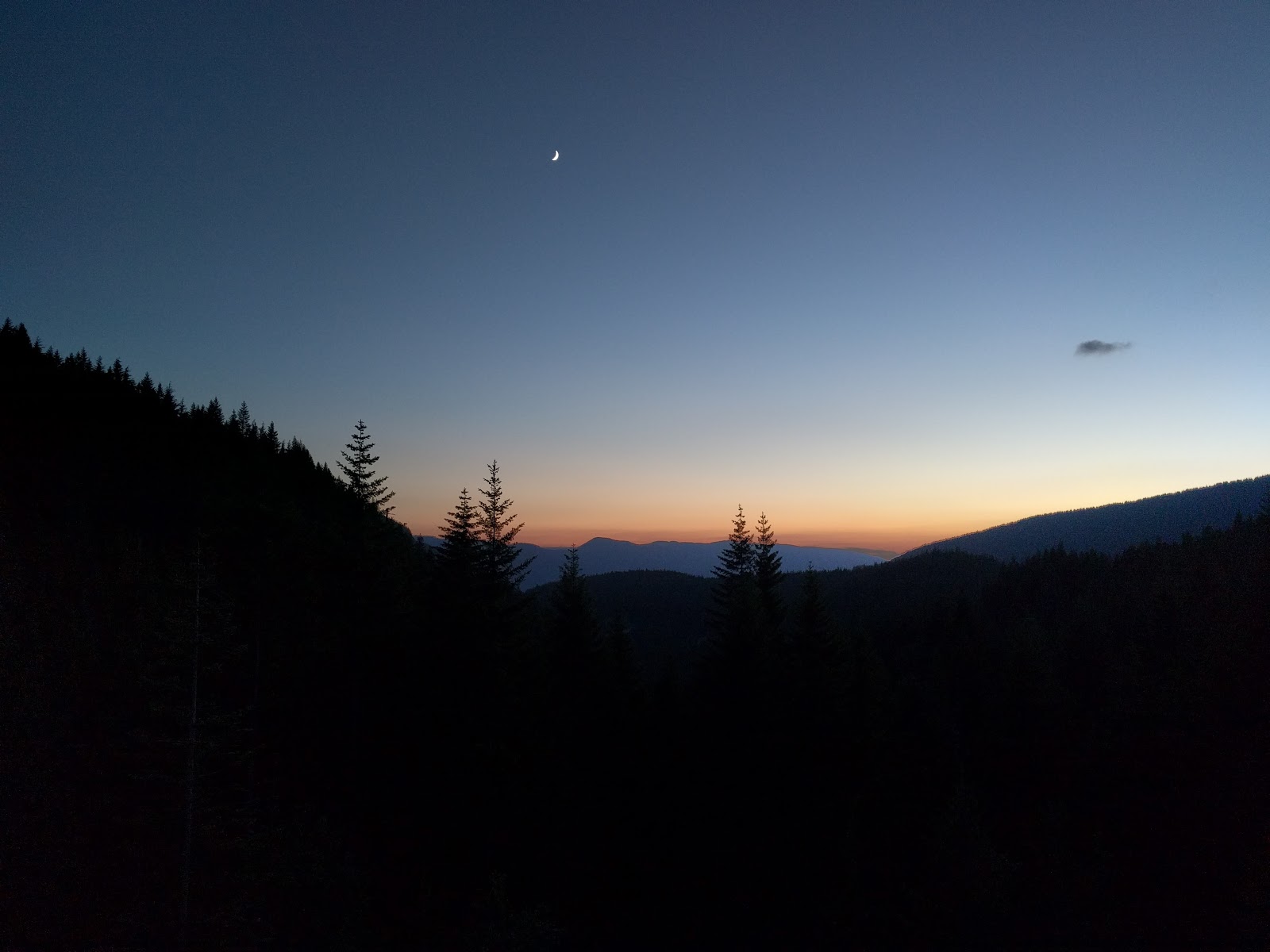
 One of the many beautiful sunsets

A lovely camping spot on soft dirt right by the road.  The guard rail was making these crazy noises probably due to the change in temperature once it got dark, and at first we thought it was a bunch of animals somewhere in the distance, it was pretty funny.

 Rolling out the next morning.  Sadly almost all the land along the road for this 100+ miles was barbed-wired off as cow pasture, and there were a lot of cows, so we were afraid to drink the creek water even through a filter.

 We saw a lot of cool old houses and contemplated how we might settle down and eke out a living in them.

 Fresh orange, red, and black currants from the roadside, and cherries we'd picked in Prineville.  The cherry tree is one block west of Good Bikes bike shop, on the main street.  We picked a lot of cherries and tried to give them away to people in the park, but everyone refused.  Happily, we filled our water at a starbucks on the way out of town and someone working there was glad to take them.

An attempt at shade for a siesta.  The day after we left Prineville was the hottest, and had the longest stretch without water of 40 miles.  Happily, two people stopped to see if we needed anything, and gave us water.  This siesta idea may have been good, but it was still too hot for me to sleep, so I basically sat or lay in the heat for four hours waiting for things to cool down.


 Weather!  Sometimes there was a cloud shadow on the road up ahead and we'd try to race toward it to get shade, but then it would move :p
  
 The final climb into the mountains of the Malheur national forest

 Rolling in to the rainbow gathering on NF-24

We went all the way to the back of the gathering up a hill, and camped on the most beautiful open hillside with tall purple flowers everywhere, and a gorgeous view of the sky.  This was the last photo before turning off my phone.  I was camped up here for about two weeks, waking up laying in the grass surrounded by chipmunks and dragonflies and all other creeping things.  By the time we left, the purple flowers had faded and orange and yellow ones were starting to bloom.

*     *     *

Two weeks later we rode back...

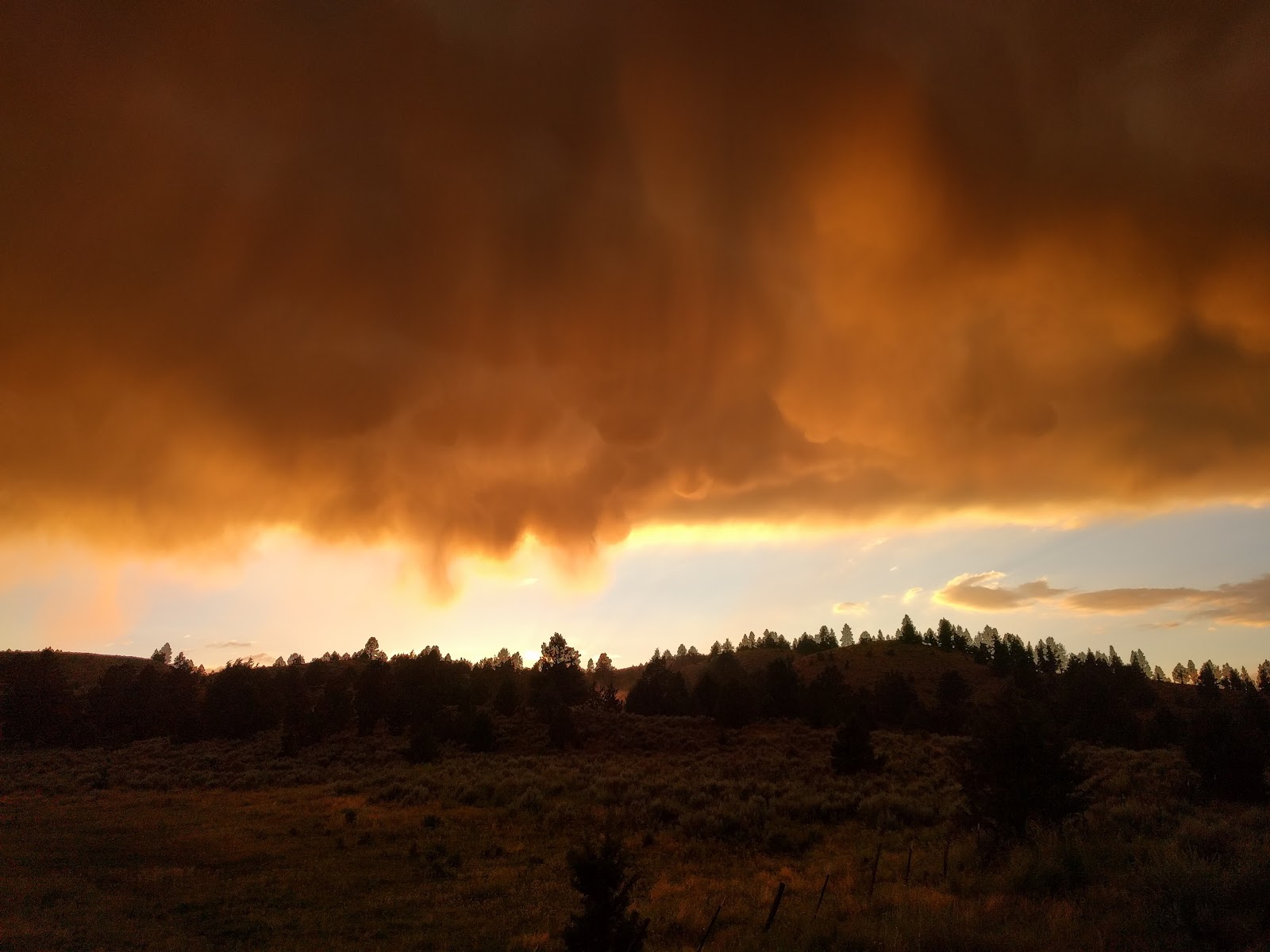
 The evening we left the gathering, we were greeted by a beautiful and refreshing storm at sunset, with a double rainbow, light rain, and lots of big lightning bolts.

 We stopped to take it in, and also watch the semi-wild horses running around, and eat currants which were now ripe at higher elevations.

 Camped for our third night just outside Prineville

 Riding toward Sisters

 At a farm stand in Sisters we bought and rescued various fruits and vegetables.  We ate most of this in one sitting.

 Going up the east side of the Cascades on 242.  There was almost no traffic.  A forest service guy said it is completely packed on weekends, but we were there tuesday and wednesday.

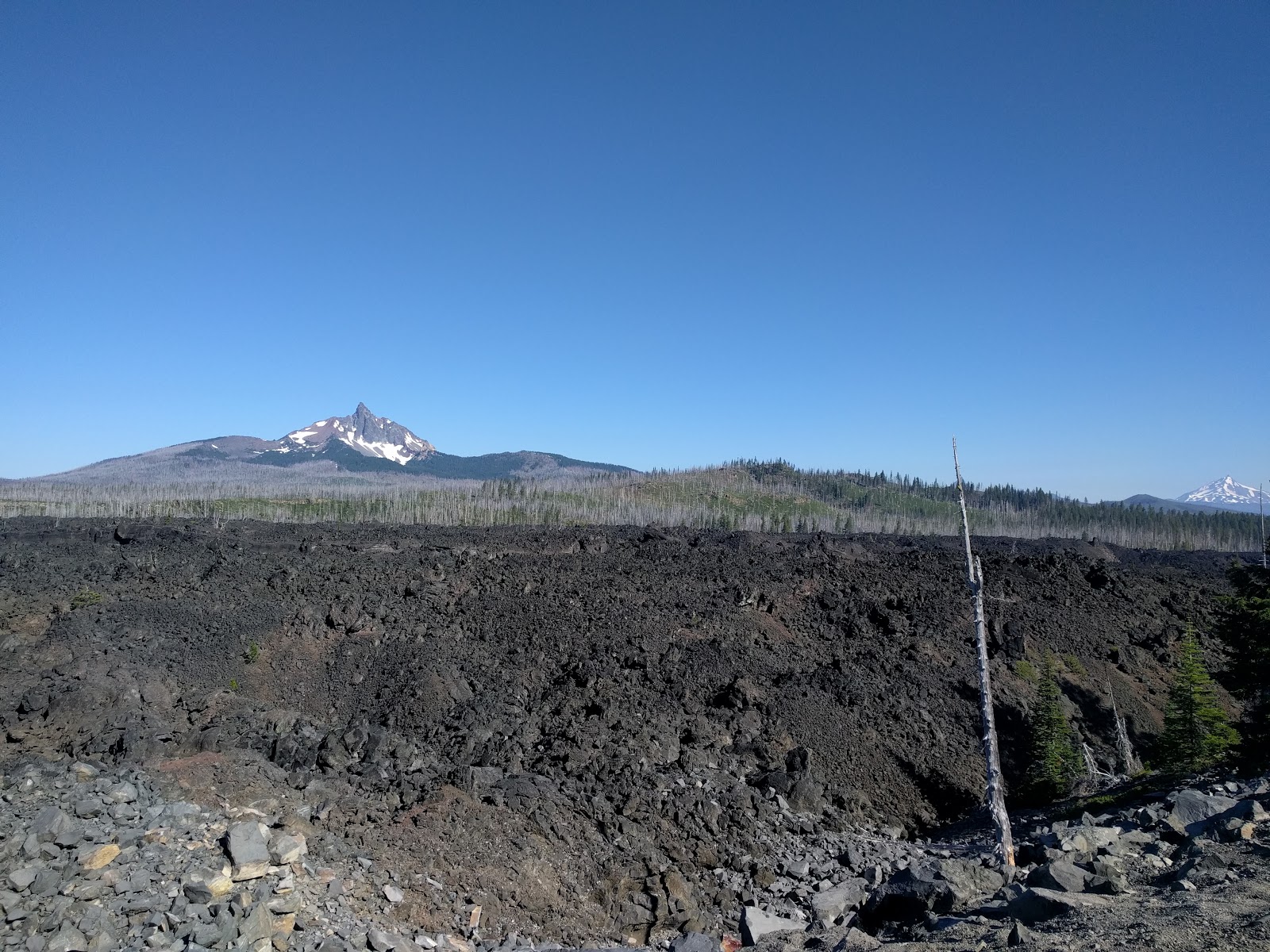
At Windy Point it looked like Mordor with piles of igneous rock everywhere

 
Hammocked just up the hill from Windy Point.  One guy who stopped there had his car make a loud beep and told his companion he thought there was "a bum" camped up there, whom he wanted to scare off.

 Mordor by day

 A beautiful lake on the way down the west side of the cascades.  At lakes, I like to make a raft and float out on it.  There were lots of dragonflies by the shore, who would fly way out on the lake and sit on this tall grass that was growing out there.


Another lake we hiked to


The Willamette river in Eugene

 Delivering Food Not Bombs in Eugene

We parted ways in Eugene, and I rode back up to Portland alone.  Now blackberries were in season, and I ate a ton of them every day.  Also shared a gallon of berries with people in the park in Corvallis.

 Soaked oats and blackberries make a delicious meal.  Yes I ate all those blackberries at one breakfast.  They're probably good for you.

 
Last sunrise on the road.